
Lifespark Engagement Initiative: Finding Champions & Driving Adoption
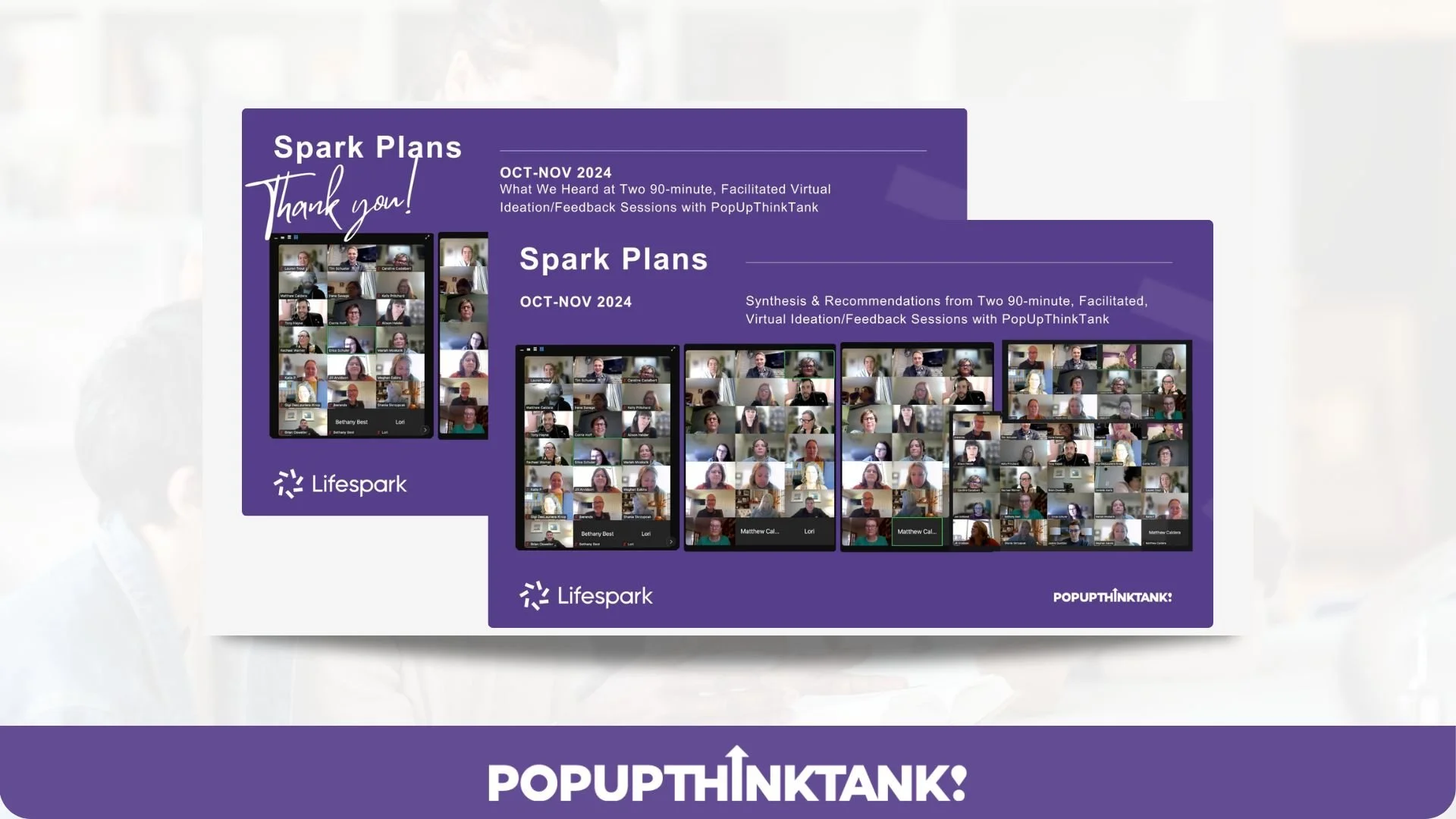
How PopUpThinkTank helped Lifespark surface early adopters, activate champions, and build momentum for a new peer-to-peer development model—before a full rollout.
Client Context
Lifespark is a growing, mission-driven senior health organization with ~3,400 employees across senior living communities and shared services. In 2024–2025, the executive and engagement teams were under pressure to improve employee retention, strengthen manager–employee cadence, and bring the Lifespark Way to life—not as another HR program, but as a lived culture.
The Spark Plan—a peer-to-peer, strengths-based development practice centered on a Spark Goal and a Spark Partner—had strong executive sponsorship and thoughtful content behind it. What was missing was not vision, but engagement, adoption, and proof.
The Real Challenge
On paper, Spark Plans made sense. In practice, Lifespark faced familiar risks:
A promising initiative that could stall without real buy-in
Uncertainty about who would actually go first
Fear of “flavor of the month” fatigue among employees
Pressure to show behavioral evidence—not just positive sentiment—before scaling
The question wasn’t Is this a good idea?
It was: How do we find the people who will actually use it, champion it, and help shape it—before we roll it out to thousands?
Why a series of PopUpThinkTank sessions?
Rather than launching Spark Plans top-down, Lifespark partnered with PopUpThinkTank to take a different approach:
Use engagement itself as the adoption strategy.
PopUpThinkTank’s 90-minute, facilitated sessions are designed not to persuade—but to invite contribution, surface honest feedback, and make it easy for people to raise their hand.
This allowed Lifespark to:
Test the Spark Plan in real time
Gather actionable input to improve the design
Identify early adopters and champions naturally—without coercion
The Approach: Ideation-as-Engagement
Over two 90-minute virtual PopUpThinkTank sessions (Oct–Nov 2024), Lifespark convened:
28 managers
18 individual contributors
Cross-functional roles spanning senior living and shared services
Each session followed a simple but intentional arc:
Context without pressure
What Spark Plans are, why they matter, and how they might work—framed as “in progress,” not finalized.
Individual reflection & small group ideation
Participants responded privately to prompts and then in small breakouts to invite honest input on past experiences with development initiatives, and asked for advice on making Spark Plans work in reality, ending with big, aspirational ideas for Lifespark’s culture.
Clear next-step signals
A closing engagement survey made it easy to say:
I want to help move this forward
I’d like to test this
I’d consider serving as a Spark Partner
No one was assigned. No one was “voluntold.”
People opted in—with clarity and agency.
The Turning Point: Who Raised Their Hand
The most important outcome wasn’t the ideas—it was who leaned forward.
Across the sessions:
91% agreed or strongly agreed it was clear why Spark Plans matter
87% said they want to help the initiative move forward
73% said they would like to be among the first to test Spark Plans
63% expressed interest in joining an employee advisory group
Even more telling:
More participants volunteered to serve as Spark Partners than to be assigned one
Participants named colleagues they believed should be involved next
Feedback revealed excitement and practical concerns—exactly what Lifespark needed to hear before scaling
This wasn’t passive approval.
It was visible, measurable willingness to go first.
What Lifespark Gained
1. A Clear Early-Adopter Signal
Instead of guessing who might engage, Lifespark could see—by name—who was ready to:
Pilot Spark Partnerships
Offer feedback
Act as champions inside their teams
2. Design Improvements Before Rollout
Participants surfaced critical insights about:
Clarity of language (Spark Plan vs. Life Plan)
Time and cadence expectations
How Spark Goals should (and should not) integrate with performance reviews
These inputs reduced risk before investing in scale.
3. Momentum Without Mandates
The sessions created energy executives could feel and reference:
4.6 / 5 average session rating
97% of participants felt they could meaningfully contribute
77% cited cross-functional breakouts as their favorite part
Spark Plans began to feel less like “another initiative” and more like something people wanted to be part of.
Why This Worked
PopUpThinkTank didn’t try to convince people to adopt Spark Plans.
Instead, it:
Created psychological safety to be honest
Offered multiple ways to participate
Treated early adopters as co-creators, not targets
Measured engagement in ways that pointed directly to action
Adoption wasn’t pushed.
It emerged.
Why This Matters for Other Organizations
This work is especially powerful for organizations that:
Are launching new tools, programs, or cultural practices
Need proof and champions before scaling
Want engagement that leads to ownership—not just feedback
Are wary of over-engineered rollouts that lose the human thread
If you’re asking:
Who will actually use this—and help it succeed?
A PopUpThinkTank is often the fastest, most human way to find out.
The best way to discover whether PopUpThinkTank is right for your situation isn’t a sales call. It’s the Session Builder— a short, guided experience designed to help: clarify the moment you’re in, surface what’s actually at stake, see what a session could unlock.
Takes less than five minutes.
And for many leaders, it creates value before they ever talk to us.