
Field Report & Session Insights
The Enterprise Facilitator
90 minutes • One big question • 30+ people working inside, alongside & across organizations
September 2026 | Tim Schuster
A Field Report from people trying to change how organizations change.
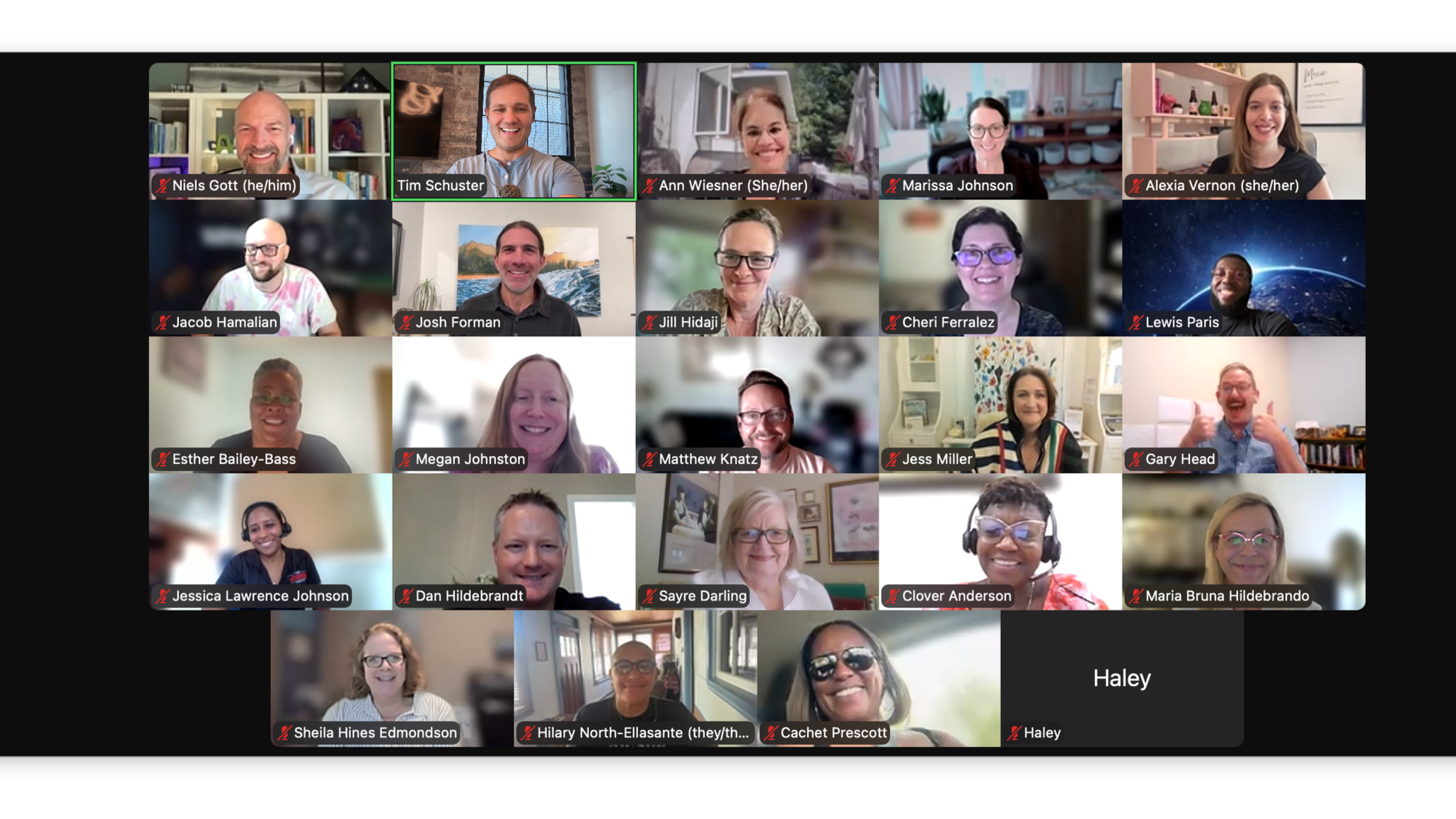
On a Friday in September 2026, a group of people working across organizations, leadership, learning, development, change, consulting, and facilitation gathered for a PopUpThinkTank.
We came with a hypothesis:
Organizations don't have an idea problem. They have a readiness problem.
New technologies. New strategies. New leaders. New structures. New expectations. New ways of working.
The solutions keep coming.
But organizations aren't machines waiting for better instructions. They're living human systems carrying histories, relationships, incentives, anxieties, identities, habits—and memories of what happened the last time someone announced the next big thing.
So we put a question in front of the room:
🧭 How might we become more ready to help our organizations become ready for what's next?
Then we got out of the way.
What follows is what the room produced.
🌫️ We started in The Driftfog.
Change is coming from above, below, across, and outside the organization.
Causality is messy. Priorities compete. Functions specialize. Information multiplies. Everyone owns a piece, while fewer people can see the whole.
And accountability hasn't disappeared just because causality got harder to trace.
We call that environment The Driftfog:
When change is everywhere, causality is unclear, and no one can see the whole—organizations can drift even while really smart people are working really hard.
Our hypothesis was that this environment calls for a different kind of organizational capability.
We gave it a working name:
The Enterprise Facilitator
Someone who sees what's really going on, convenes the right conversations, and creates the conditions for movement.
Not simply a trainer.
Not simply a meeting facilitator.
Not simply a change messenger.
Someone paying attention to the human system around the change—not just the change itself.
And then we asked the room what they saw.
🪞 First, the idea became personal.
Before anyone talked with anyone else, we asked participants to reflect individually:
I Like → What resonates?
I Wish → What could be different, clearer, or more possible?
I Wonder → What question or possibility is this opening?
Something became clear quickly:
For some people, The Enterprise Facilitator wasn't a new job description.
It was a name for work they were already doing.
One participant described the concept as something that:
“makes the invisible work visible.”
Another appreciated having language for:
“a role I've been informally playing in my org.”
But naming it raised new questions.
Where does this capability live?
Is it OD? L&D? Change? Strategy? Leadership? Consulting?
Is facilitator even the right word?
What authority does this person need?
How do you build credibility without being typecast as the person who runs meetings, delivers training, manages the project plan, or communicates somebody else's decision?
The name created recognition.
It also exposed how unfinished the role still is.
💭 Then we asked: What does organizational change actually feel like?
This is where the conversation shifted. The room didn't primarily give us frameworks. It gave us human experience.
Anxiety. Grief. Fatigue. Cynicism
Overwhelm. Identity. Belonging. Control.
Urgency. Disconnection. Hope.
One group captured a familiar experience:
“Change is done to you or for you, but not with you.”
Another noticed where the real conversation often happens:
“The real feelings about change show up in informal settings, not the formal meetings.”
And another surfaced something we don't hear often enough:
“Change fatigue isn't talked about anymore... you're not allowed to actually feel or talk about it.”
The conversation moved beyond whether an initiative was being communicated effectively.
People talked about what constant change does to capacity, creativity, trust, relationships, identity—and even the nervous system.
One participant wondered:
How might facilitation give people permission to drop out of their heads and into their bodies?
That wasn't part of our original hypothesis.
The room put it there.
📡 SIGNAL 01
Change has an emotional balance sheet.
We introduced the idea of organizational debt:
Every new initiative inherits the organization's experience of the last one.
The room took that idea further.
Failed or abandoned change doesn't simply create implementation problems.
It leaves residue.
People remember.
They remember the initiative that disappeared.
The leader who left.
The feedback that went nowhere.
The “transformation” that became another flavor of the month.
The thing they were asked to care deeply about—and then quietly stop talking about.
Eventually, people learn how much emotional energy they should risk investing in the next thing.
Readiness has a history.
And sometimes what looks like resistance to the next initiative is actually a perfectly rational response to the last five.
📡 SIGNAL 02
Resistance might be intelligence.
One of the clearest practical ideas from the room was also one of the simplest:
“Those that are resistant to change still have something to give.”
What if resistance isn't merely something to overcome?
What if it's information?
The skeptic might see a dependency others missed.
The late adopter might expose an impractical assumption.
The frustrated employee might be carrying organizational memory.
The person saying “this won't work here” might know something worth understanding before we explain why they're wrong.
Resistance can be signal.
The Enterprise Facilitator doesn't have to eliminate it.
They can become curious about it.
📡 SIGNAL 03
Slowing down can create movement.
A fascinating pattern appeared across the conversation:
Pause.
Make small, iterative moves.
Create room for reflection.
Experiment before scaling.
Prioritize.
Notice what's happening.
Make assumptions visible.
Ask what can be removed—not merely what else needs to be added.
The question underneath many of these ideas seemed to be:
What is the appropriate speed of change?
Organizations often equate movement with speed.
But readiness might require a different capability:
knowing when to move quickly—and when moving more slowly now allows the system to move much faster later.
A pause isn't necessarily stalled progress.
Sometimes it's the system getting ready.
📡 SIGNAL 04
Don't ask for participation if nothing can be influenced.
We talked about feedback differently.
Not:
“How do we incorporate everyone's idea?”
But:
“How do we make sure people are heard, considered, and able to shape what comes next?”
The room sharpened the point.
“Don't ask for advice if you don't want it; otherwise, it's performative. It erodes trust.”
People understand that not every idea becomes policy.
Tradeoffs are real.
Leaders still have to lead.
Decisions still have to be made.
But inviting people into a process while withholding any meaningful possibility of influence isn't co-creation.
It's theater.
Participation without influence can create more organizational debt than not asking at all.
📡 SIGNAL 05
Maybe the intervention matters as much as the innovation.
Organizations invest tremendous energy designing the thing:
The strategy.
The software.
The restructure.
The new program.
The acquisition.
The leadership model.
The goal.
Then comes:
“And we'll roll it out.”
But how a living human system encounters something new isn't an implementation detail.
It's part of the design.
The room generated practical possibilities:
⚡ Start with small experiments.
🤝 Bring affected people in earlier.
🪞 Make room for reflection.
💬 Create real feedback loops.
🧠 Surface assumptions.
🫶 Hold candor and care together.
📡 Map energy, not only stakeholders.
🌱 Create psychologically safe spaces for people to wrestle with what's changing.
🧭 Find the people ready to go first.
🎉 Make small wins visible.
None of these eliminates complexity.
They help people move inside it.
✨ Ideas we don't want to lose
Not every idea needs to become a framework.
Some deserve to stay exactly what they are:
provocations worth carrying forward.
🕯️ Memorialize the loss.
When something is changing, explicitly name what is being lost. Ask what people valued about it—and what deserves to travel forward.
⚡ Map the energy.
Don't only ask who the stakeholders are. Ask where energy, curiosity, frustration, ownership, and willingness already exist.
✂️ Ask what we can stop.
Readiness isn't always created by another initiative, meeting, training, communication, or intervention.
Sometimes capacity comes from subtraction.
🫀 Remember who's driving the bus.
Organizations may look rational on an org chart.
Human nervous systems are still involved.
🤲 Candor + care.
Truth and kindness aren't competing organizational values. Sometimes people need both before they can take a meaningful risk together.
🏘️ Maybe organizations aren't families.
What if community is a more useful metaphor?
A place where people can belong, contribute, disagree, leave, return, hold different responsibilities—and still care about the whole.
🧪 Installation or realization?
Are we trying to install a program?
Or create a different reality?
Those lead to very different interventions.
🌱 Then we asked people to dream.
The final question was deliberately expansive:
What becomes possible when we get better at how we change?
We expected ideas about organizations.
We got those.
Better adoption.
More resilient teams.
Less wasted energy.
More effective change.
Stronger organizations.
But people kept going.
They imagined:
“Humans flourish!”
They imagined:
“joy, fun, relationship, connection.”
They imagined:
“The world would be a kinder place.”
And they imagined ripple effects:
Positive experiences at work flowing into people's families, relationships, communities, and lives outside of work.
Suddenly this wasn't merely about better change management.
It was about the environments in which human beings spend enormous portions of their lives.
Maybe better organizational change doesn't only create better organizations.
Maybe it creates better experiences of being human inside them.
💛 And then something happened in the room.
At the end of 90 minutes, we put one sentence on the screen:
“I didn't expect to feel ______ today.”
Remember:
Most participants didn't know one another.
Many had never attended a PopUpThinkTank.
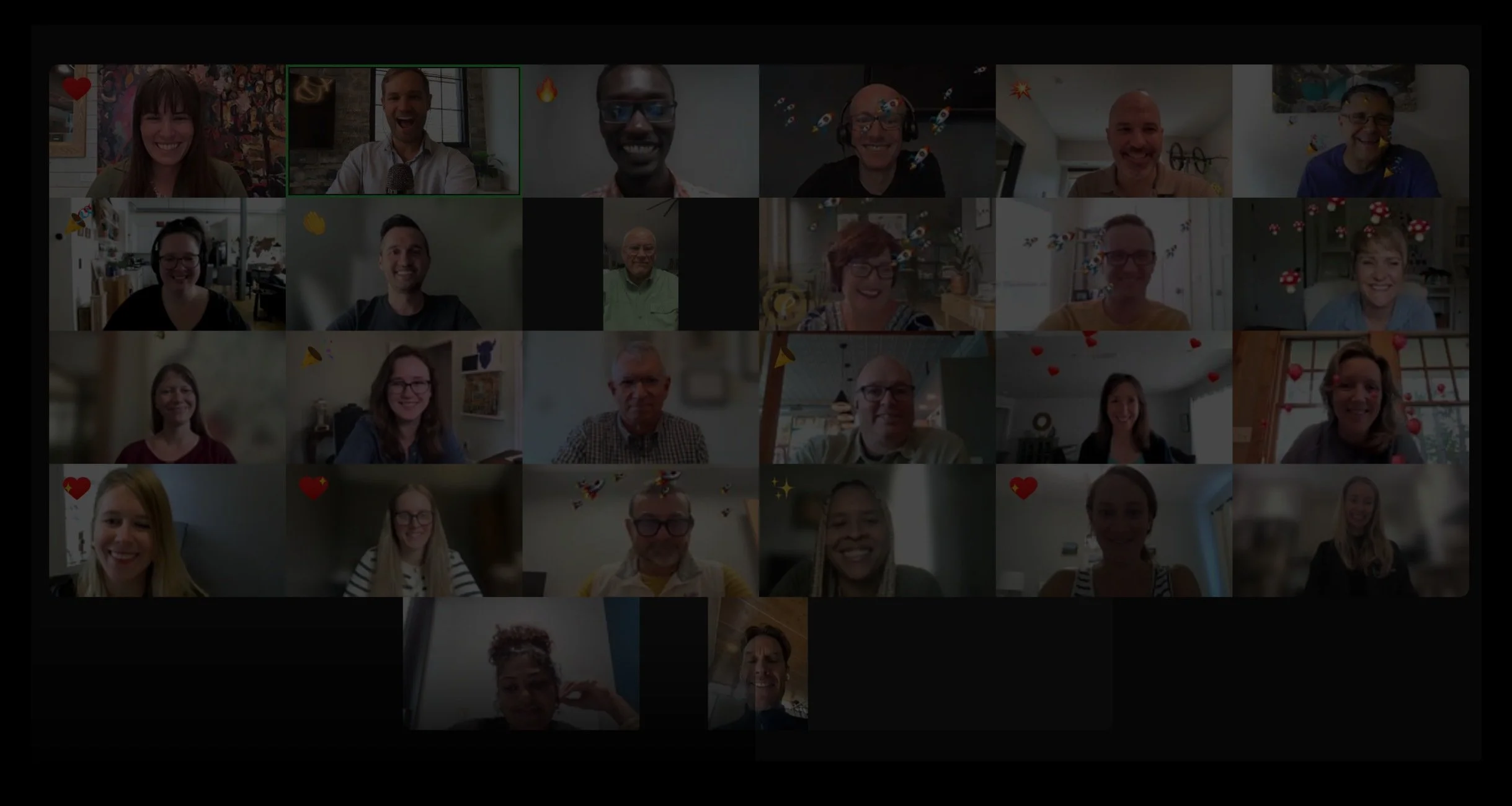
They'd spent their time moving through Zoom breakout rooms with strangers, exchanging stories and generating ideas about a complicated organizational problem.
And then people started answering.
“Connected.”
“Elevated. Engaged. Contributive.”
“Hopeful.”
“Awed by some of my peers' thinking.”
“So resonant with fellow practitioners.”
One participant—a facilitator herself—said she normally hides in the back when someone else is facilitating.
And Zoom fatigue?
Very real.
Yet she told the room:
“I did not expect to feel connected and energized by this conversation, particularly on Zoom.”
Another participant noticed something even more interesting:
“I did not expect to feel like how we want people to feel when we are working on a change project.”
Engaged. Connected. Curious. Energized.
And then one participant brought the conversation all the way back to what this might ultimately be about:
“Everything would just be a lot kinder if we were kinder in how we did change.”
For 90 minutes, we hadn't only been discussing the conditions for better change.
For a brief moment, the room experienced some of them.
👀 What we didn't hear
Collective intelligence includes what's spoken.
It can also be useful to notice what's missing.
There are important parts of this conversation we barely touched.
⚖️ Power
Who actually gets to decide?
Who can safely disagree?
Whose input carries weight?
What happens when the intervention surfaces something leadership doesn't want to hear?
Power appeared around the edges of the conversation, but deserves much more attention.
💰 Incentives
We talked about relationships, trust, safety, feedback, energy, and participation.
Much less was said about performance systems, budgets, compensation, career consequences, KPIs, and competing incentives.
Human systems aren't shaped by culture alone.
📊 Evidence
Does greater co-creation actually produce greater adoption?
When?
For what kinds of change?
How would we know?
The room gave us compelling hypotheses.
It didn't give us proof.
That's work still worth doing.
🪪 Authority
If The Enterprise Facilitator is a real organizational capability, where does it sit?
What mandate does it require?
How does someone earn permission to convene across silos, levels, and functions?
And how do we prevent “facilitator” from being interpreted as simply the person who runs the meeting?
❓ One question underneath “Are we ready?”
We spent considerable time asking:
Are we ready for this change?
But another question remains:
Is this change worthy of readiness?
Helping an organization absorb change is not the same as assuming every proposed change deserves to be absorbed.
That distinction matters.
🔭 The hypothesis changed.
We entered the room thinking about The Enterprise Facilitator as someone who:
sees what's really going on,
convenes the right conversations,
and creates conditions for movement.
We still believe that.
But the room made the idea bigger.
The Enterprise Facilitator might also be someone who:
🧭 helps the organization see itself
📡 detects signal hiding inside resistance
🫀 remembers that change happens to bodies, identities, and relationships—not just org charts
⚡ finds where energy already exists
🪞 creates enough pause for people to notice what's actually happening
🤝 helps people influence change without pretending everyone gets their way
🧪 turns ambiguity into experiments instead of premature answers
🌐 helps specialized parts see more of the whole
And perhaps most importantly:
They don't simply help organizations execute change.
They help organizations become better at changing.
🚧 This isn't finished.
We came into the room with a hypothesis called The Enterprise Facilitator.
Ninety minutes later, the hypothesis was messier.
And better.
We heard that organizational change isn't simply a problem of communication, implementation, or adoption.
It is experienced as grief, energy, identity, belonging, power, possibility, anxiety, connection—and sometimes exhaustion.
We heard that resistance can contain intelligence.
That slowing down can create movement.
That asking for feedback creates an obligation to genuinely listen.
That the intervention deserves as much imagination as the innovation.
And that better change might not merely produce more successful initiatives.
It might create healthier organizations and more human experiences inside them.
Perhaps most interestingly, people who came together to discuss how organizations might change differently left describing themselves as:
Connected.
Energized.
Contributive.
Hopeful.
We don't think that's the answer.
We think it's a signal.
🧭 Questions we're carrying forward
What does it take to legitimize The Enterprise Facilitator as an organizational capability?
Where should this capability live—and does it need to live anywhere?
What authority, sponsorship, and proximity to power does the role require?
How do we know when participation is genuinely shaping change versus merely creating the appearance of involvement?
What would it look like to measure organizational readiness rather than simply adoption?
How do we design interventions for grief, identity, energy, and belonging—not merely information and behavior?
What evidence would tell us this approach actually creates more durable change?
And perhaps the biggest question:
What becomes possible when we change how we change?
This Field Report was created from the individual reflections, group-generated ideas, conversations, and closing observations of participants in The Enterprise Facilitator PopUpThinkTank on September 11, 2026. It represents collective intelligence from the room—not a claim of consensus. Participant contributions have been selectively surfaced to preserve the vitality of the conversation while making the larger patterns visible.
Ready to Facilitate?
Coaches & consultants: Explore the Independent Path →
L&D, OD/OE & Change practitioners: Explore the Enterprise Path →
Ready to Facilitate?
We’ll get you ready—and support you as you put it to work.Two paths, depending on where you want to create impact: through your own practice or inside your organization.
Independent Facilitator
Bring PopUpThinkTank into your own work.
For coaches, consultants, facilitators, and independent practitioners who want a powerful new way to convene people, create momentum, and expand what they can offer clients.
Coaches • Consultants • Independent Practitioners
Explore the Independent Path →
Enterprise Facilitator
Build the capability from the inside.
For practitioners inside large, complex organizations who are helping people navigate change, build readiness, and move important work forward.
L&D • OD/OE • Change • Talent • Culture